

















Tokyo, one neighbourhood at a time
Six Tokyo neighbourhoods, from temple lanes to riverside cafés, paired so that each day has room to breathe.
By The YuzuSIM travel team · 4 min read
Pace Tokyo in pairs
Tokyo rewards a slower plan. Instead of crossing the whole city every day, choose two neighbourhoods that sit well together, give each one a morning or an afternoon, and let the gaps fill themselves with coffee, side streets and the odd detour.
The pairings below follow that idea. An IC card such as Suica or PASMO keeps the hops simple: you tap it to move between train lines and board buses, and it works at a number of convenience stores and vending machines too.
Asakusa and Yanaka
Asakusa sits on the Sumida River in eastern Tokyo. Its heart is Senso-ji, a temple complex you enter through Kaminarimon, a huge gate hung with a giant red lantern. Past the gate, Nakamise shopping street is lined with small stalls selling souvenirs and snacks. Walk down to the red Azuma-bashi Bridge for a view across the river to Tokyo Skytree.
Asakusa Station is on the Tokyo Metro Ginza Line, the Toei Asakusa Line and the Tobu Skytree Line.
Yanaka, with its neighbours Nezu and Sendagi, is known together as Yanesen. The area is part of shitamachi, Tokyo’s old downtown, and it came through wars and natural disasters without major damage, so its lanes still carry the feel of the last century.
A few places to wander:
- Yanaka Ginza, a lantern-lined shopping street with around 60 shops along 170 metres, known for cat-shaped snacks and statues of the Seven Lucky Cats.
- Yanaka Cemetery, known for its trees and its cherry blossom in spring.
- Nezu Shrine, with bright red torii tunnels, a pond of colourful carp and an azalea festival in April.
For Yanaka, use Nippori Station on the JR Yamanote Line, or Nezu and Sendagi stations on the Chiyoda Line. A gentle plan: Asakusa in the morning, then Yanaka’s side streets after lunch.
Shibuya and Nakameguro
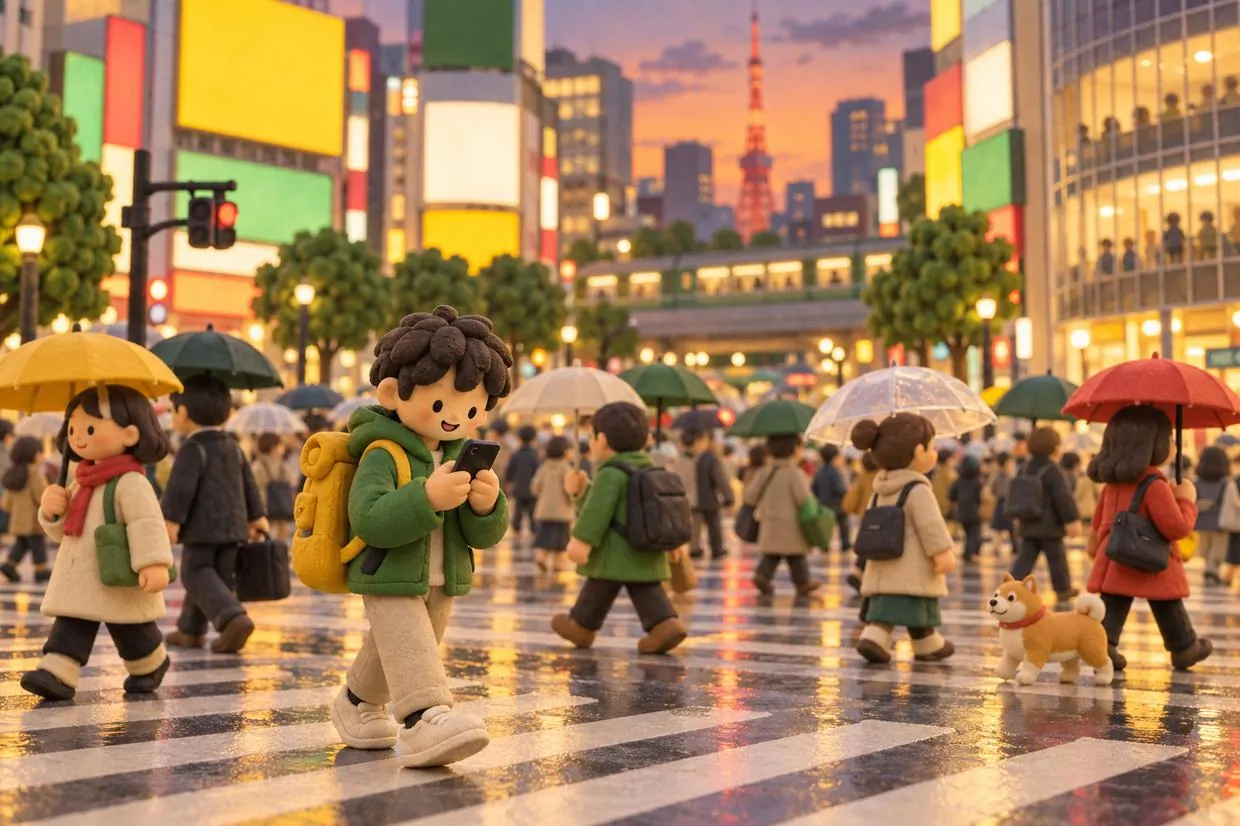
Shibuya is the city at full volume. Outside the station, crowds pour across the scramble crossing roughly every two minutes. For the view from above, Shibuya Sky in Shibuya Scramble Square has a 360-degree observation deck about 230 metres up.
Shibuya also works well as a walking base. GO TOKYO puts Aoyama, Omotesando and Harajuku about 20 minutes away on foot, and Daikanyama about 15.
Nakameguro is on the Tokyu Toyoko Line, which you can pick up at Shibuya, and on the Tokyo Metro Hibiya Line. The Meguro River runs through the middle, lined with cherry trees whose blossom peaks from the end of March into early April, with evening illumination and big crowds in season. For the rest of the year, the riverside is a quieter mix of vintage shops, galleries, cafés and small restaurants.
Under the railway tracks, Nakameguro Koukashita has turned a once empty space into a strip of cafés, restaurants and shops, including a Tsutaya bookshop with reading spaces and pop-up exhibitions.
From Nakameguro you can walk to Daikanyama in about 10 minutes, and from Daikanyama back towards Shibuya, which makes a neat afternoon loop on foot.
Shinjuku and Shimokitazawa
Shinjuku is busy from the ticket gates up, but two calm spots are close at hand:
- Shinjuku Gyoen, once part of the imperial gardens, with wide lawns and the skyline beyond. Alcohol, smoking, sports equipment and musical instruments are not allowed inside.
- The Tokyo Metropolitan Government Building, whose observation decks on the upper floors are free to visit.
After dark, Kabukicho is the other side of the neighbourhood, with neon streets and tiny bars stacked on top of one another.
Shimokitazawa is seven minutes from Shinjuku on the Odakyu Line, and it is also on the Keio Inokashira Line. GO TOKYO calls it a laid-back, bohemian district, and it does feel a notch calmer than its big neighbours. Come for vintage clothing, small theatres and cinemas, bookshops and music shops, and cafés with quirky interiors. Newer spaces such as Mikan Shimokita and Reload add restaurants, shops and a gallery-like bookshop.
Shinjuku’s energy in the morning, then Shimokitazawa’s side streets in the afternoon, make a good contrast for a single day.
Keeping each day light
A few habits help every Tokyo day go smoothly:
- Save each stop offline. Keep the station name and address for each place you plan to visit, so a low battery or a patchy moment does not leave you guessing.
- Leave one gap. A free hour in the afternoon gives you somewhere to put the café you did not plan, or the rest you did not expect to need.
- Pick your pair the night before. Choose the two neighbourhoods, check how they connect, and go to bed with the first station saved.
- Sort your eSIM before you fly. Read your plan’s activation rule before the trip and keep your order link somewhere safe, so your first morning starts with a working phone rather than a setup task.
There is no need to see it all at once. One neighbourhood at a time is plenty.
A little data for the detours.
Compare Japan plans and choose the one that fits your trip.
Shop Japan eSIMs